
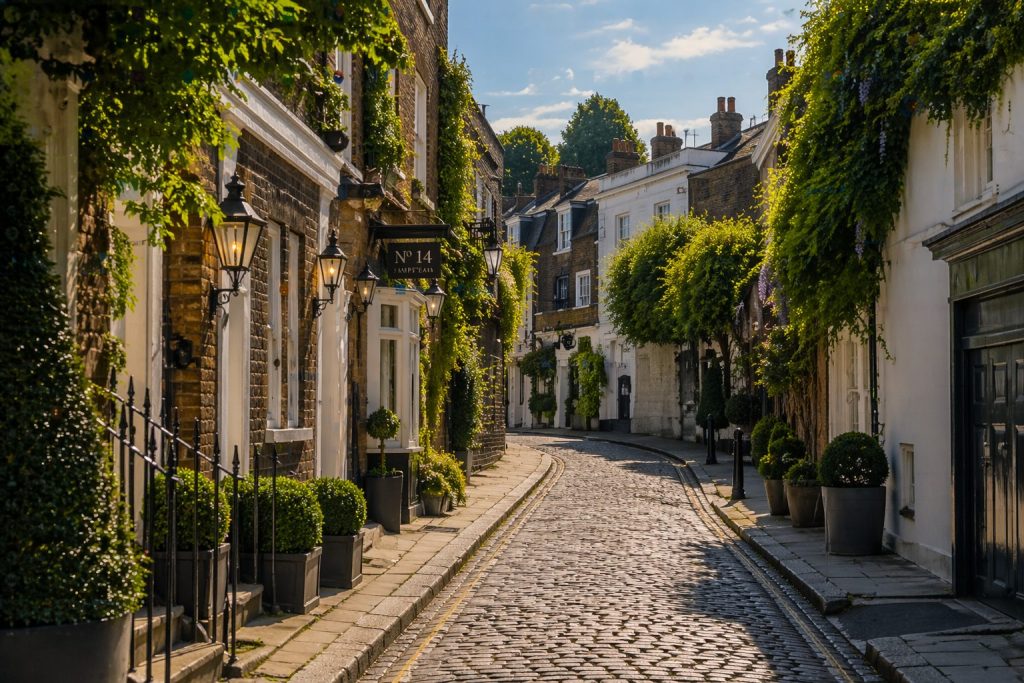
Hampstead does not feel quite like anywhere else in London.
It has winding lanes, steep hills, handsome period houses, old pubs, independent shops and one of the capital’s greatest open spaces sitting on its doorstep. It feels established without being frozen in time and refined without losing its personality.
The centre of Hampstead still has the character of a village, despite being only a few miles from central London. Streets such as Church Row, Flask Walk and Holly Walk contribute to a sense of history that is not manufactured for visitors. People live here because they enjoy the area itself, not simply because it provides a convenient address.
Hampstead Heath changes the rhythm of everyday life. It offers woodland, meadows, swimming ponds, walking routes and extraordinary views across London. Few neighbourhoods so close to the centre of the capital provide this much open space.
Living in Hampstead
Living in Hampstead feels calmer than living in many other parts of London, although it is not a quiet country village.
Hampstead High Street can be busy, particularly at weekends, and the hills are real. Parking can be difficult, properties can be expensive and some of the older homes require careful maintenance.
However, the attraction is easy to understand. Residents have cafés, shops, restaurants and cultural landmarks nearby, while Hampstead Heath provides an immediate escape from city life.
The area attracts families, professionals, creative people and long-term residents. Some buyers want a substantial house close to the Heath, while others prefer a period flat within walking distance of Hampstead Underground station.
Daily life tends to centre around Hampstead Village, the High Street and the Heath, but the character changes as you move towards Frognal, South End Green, Belsize Park, Finchley Road and the edges of Highgate.
Where is Hampstead?
Hampstead sits in north London within the London Borough of Camden. The area lies beside Belsize Park, Highgate, South Hampstead, Swiss Cottage and Finchley Road. However, the boundaries people use in everyday conversation do not always match official ward or conservation area boundaries.
This matters when buying or renting. A property marketed as being in Hampstead may sit some distance from Hampstead Village or the Heath.
The best approach is to consider the precise street, walking route and nearest transport connection rather than relying entirely on the name used in the property description.
The character of Hampstead
Hampstead’s character comes from its landscape as much as its buildings. The village developed around narrow lanes, steep streets and small squares. Hampstead’s conservation area still shows evidence of its eighteenth-century village, Victorian expansion and important twentieth-century architecture.
There is considerable variety within a relatively small area. You will find Georgian houses, Victorian villas, red-brick mansion blocks, cottages, modernist buildings and more recent apartments.
Mature trees, established gardens and glimpses of the Heath soften the architecture and help Hampstead feel far removed from the centre of London. This variety also means that two neighbouring streets can offer very different homes and surroundings.
Hampstead’s history
Hampstead has ancient roots. Land at “Hemstede” was recorded as early as 986, and the settlement later appeared in the Domesday Book of 1086. Its name is generally understood to mean “homestead”.
Much of its later growth began during the seventeenth century. In 1700, trustees promoted the supposed medicinal qualities of Hampstead’s iron-rich spring water.
A pump room and assembly room opened around Well Walk, and Hampstead became a fashionable spa destination. The spa eventually lost popularity as other resorts attracted visitors, but the village continued to develop.
The arrival of the railway during the nineteenth century and the opening of what is now the Northern Line in 1907 made travel into central London much easier.
Large houses appeared around areas including Frognal and Fitzjohn’s Avenue, while the village retained many of its older lanes, cottages and terraces.
Property in Hampstead
Hampstead has one of the most varied and distinctive property markets in north London. The area includes substantial detached and semi-detached houses, Georgian and Victorian terraces, cottages, mansion flats, period conversions and modern apartments.
Some of the most desirable homes sit close to Hampstead Heath or within the streets surrounding the Village. Properties in Frognal and around Fitzjohn’s Avenue often provide larger houses and more generous gardens.
Apartments range from converted flats in period houses to mansion blocks and important modernist buildings. The condition and history of a property can matter considerably.
Listed status, conservation area restrictions, lease length, service charges and planned major works may all affect its value and saleability. Parking, outside space and proximity to the Heath can also make a significant difference.
A home on a quiet residential road may attract a different buyer from a flat close to Hampstead High Street, even when both properties offer similar accommodation.
Hampstead property market
The Office for National Statistics publishes official property information for the wider London Borough of Camden. These figures cover many areas beyond Hampstead, so they provide market context rather than a valuation of an individual Hampstead home.
The provisional average house price in Camden was £815,000 in July 2026. This was 10.1% lower than the revised average of £907,000 recorded in July 2025.
First-time buyers paid an average of £712,000, which was 10.3% lower than the previous year.
Average prices by property type were:
- Detached homes: £3,645,000
- Semi-detached homes: £2,118,000
- Terraced homes: £1,555,000
- Flats and maisonettes: £671,000
Private rents across Camden averaged £2,819 per month in August 2026. This represented an annual increase of 1.0%.
Average monthly rents by number of bedrooms were:
- One bedroom: £2,054
- Two bedrooms: £2,621
- Three bedrooms: £3,055
- Four or more bedrooms: £3,967
Local property data draw on fewer transactions than national data, so short-term figures can move noticeably. The Office for National Statistics may also revise the house price figures as further completed sales enter the records.
Hampstead contains some of Camden’s most valuable homes, which means an individual property may sit well above the borough average.
What the figures mean for buyers and sellers
The fall in Camden’s average sale price does not mean that every Hampstead property has fallen by 10.1%.
Borough-wide figures combine many different neighbourhoods and property types. They cannot account for the condition, architecture, street, outlook or history of an individual home.
Hampstead’s property market can be highly specific. A house with a garden near the Heath may face very little direct competition, while a flat in a mansion block may compete with several similar properties.
For leasehold homes, buyers will look closely at the remaining lease, service charges, building condition and any planned works.
Sellers need to understand the evidence and the competing properties available at the time. Hampstead’s reputation may attract attention, but it does not remove the need for careful pricing and good presentation.
Hampstead Heath
Hampstead Heath is not simply somewhere residents visit on a sunny weekend. It forms part of everyday life in the area.
The Heath covers approximately 790 acres of grassland, woodland, meadows, wetlands, formal grounds and heathland.
Its size means there is no single Hampstead Heath experience. You can walk through woodland, cross open fields, visit the ponds, follow paths towards Highgate or stop at Parliament Hill for views across London.
The Heath’s swimming culture is also an important part of local life. Kenwood Ladies’ Pond, Highgate Men’s Pond and Parliament Hill Lido open throughout the year. Hampstead Mixed Pond operates seasonally.
For walkers, runners, swimmers, families and dog owners, having such an extraordinary landscape nearby can change the experience of living in London completely.
Parliament Hill and views across London
Parliament Hill provides one of the best-known views across the capital. Its name dates from the seventeenth century, when Parliamentarian forces used the hill as a lookout during the English Civil War.
Today, people come for the skyline, open space and walking routes. For residents, it can be somewhere to exercise before work, meet friends or take a walk without planning an entire day around it. The climb is part of the experience, but the view makes the effort worthwhile.
Hampstead Village
Hampstead Village is centred around Hampstead High Street and the network of older streets surrounding it. The High Street provides everyday shops alongside cafés, restaurants and independent businesses. Flask Walk adds antique shops, smaller businesses and a more intimate village atmosphere.
Church Row, with its handsome period houses and view towards Saint John-at-Hampstead, is one of the streets that captures the area’s historic character particularly well.
The lanes, passages and steep streets make Hampstead enjoyable to explore, although they can also make driving and parking less convenient. The Village feels lived in rather than designed as a visitor attraction. That authenticity remains one of its strongest qualities.
Food, pubs and local life
Hampstead offers a good choice of cafés, restaurants, bakeries and pubs, but it is the setting as much as the individual venues that makes going out locally enjoyable.
A morning coffee can become a walk across the Heath. Lunch in the Village can lead to Flask Walk or a visit to one of the area’s historic houses. Traditional pubs remain part of Hampstead’s identity, alongside newer restaurants and cafés. The area has enough variety for residents to stay local without feeling restricted.
At weekends, the High Street and Village can become busy. People who prefer quieter surroundings may want to explore the residential streets or the South End Green side of the Heath.
Culture, architecture and notable places
Hampstead has a long association with writers, artists, actors and intellectual life. Keats House is the Regency villa where the Romantic poet John Keats lived from 1818 to 1820. The house now celebrates his life and work.
Burgh House contains Hampstead Museum and hosts exhibitions, talks, concerts and events. Fenton House provides another glimpse into Hampstead’s history, while the Freud Museum occupies the final home of Sigmund Freud.
On the edge of Hampstead Heath, Kenwood House combines historic interiors, landscaped gardens and an internationally significant art collection. Entry to the house is free, although booking is recommended. Hampstead is also home to important Modernist architecture, including the Isokon Building and Ernő Goldfinger’s influential home at 2 Willow Road
This concentration of history, architecture and culture gives the area much of its depth. Hampstead is beautiful, but it is not beautiful in only one architectural style.
Transport and connectivity
Hampstead Underground station sits on the Northern Line and provides services towards central London. The station opened in 1907 and is known for being the deepest station on the London Underground network.
Hampstead Heath station, on the Mildmay line of the London Overground, offers another useful connection from the South End Green side of the area. Nearby stations include Belsize Park, Finchley Road and Swiss Cottage, although the most convenient option will depend on the individual street.
Hampstead’s hills can make walking times feel longer than they appear on a map. Anyone considering a property should walk the route to the station rather than judging it entirely by distance. Bus services provide further connections across north and central London.
Schools and family life
Hampstead is popular with families because of its residential streets, green space and range of schools and nurseries.
However, families should research individual schools carefully. Admissions arrangements, priority areas and eligibility requirements can change, and living nearby does not automatically guarantee a place.
The needs of family life may also affect the type of Hampstead property that works best. Storage, outside space, stairs, parking and the daily journey to school can matter as much as the number of bedrooms.
The Heath provides an exceptional outdoor environment, but buyers should still consider how the individual street and property will work throughout the week.
Daily life in Hampstead
Hampstead can feel peaceful, but it is not sleepy. The Village has a steady rhythm throughout the week, and the Heath brings walkers, swimmers, runners and visitors into the area throughout the year.
There are practical compromises. Some properties have limited parking, older homes can require regular maintenance and the hills will not suit everyone. The area can also become busy at weekends, particularly in good weather.
Yet these details are part of living in a real London neighbourhood rather than an idealised village. Hampstead offers beauty and history, but it also has schools, hospitals, transport, shops and the everyday activity of a well-established community.
Why people choose Hampstead
People choose Hampstead because it offers something increasingly rare in London. You can live close to central London while having open countryside-like space at the end of the road. You can walk through streets shaped over several centuries and still travel into the centre for work.
The property is varied, the architecture has genuine depth and the local culture extends beyond shops and restaurants. Hampstead suits people who value character, greenery and a strong sense of place. It is not the easiest or least expensive part of London, but for many residents that combination makes it difficult to leave.
Buying, selling or letting in Hampstead
If you are considering buying, selling or letting in Hampstead or the surrounding north London area, Properly can help you understand the market and how buyers or tenants are likely to respond to your property.
Every Hampstead home has its own character. Good advice should consider the individual street, architecture, condition and likely audience rather than relying only on the reputation of the postcode.
If you own a rental property and would like to understand the costs and responsibilities involved, read our property management cost guide.
Whether you are planning a move, considering letting your property or would simply like an informed conversation about its value, please contact Properly.
Sources
Kenwood information from English Heritage
Hampstead history and local information
Hampstead Conservation Area Design Guide from Camden Council
Hampstead Heath information from the City of London Corporation
Hampstead Underground station information from Transport for London
Camden house prices and rents from the Office for National Statistics